
Recent Articles
- Jack Charles, Jayne Watson and the Fight for Real Stories
- Francis Lickerish: Q&A
- The Power of a First Line: On Tim Robinson’s Hatham Hall
- Q&A with Jack Charles
- Q&A with Lindsey Mellon
2023-05-05 | Q&A
Emily Prescott (EP):It may sound lazy but I think it’s the length. My first favourite poem was Carol Ann Duffy’s Mrs Dawnin: 7 April 1852. Went to the Zoo. I said to Him – something about that Chimpanzee over there reminds me of you. I like to think my love of short poems is not just due to a limited capacity for concentration — short poems have to capture feelings and experiences so quickly: Like a mood photograph.
Ruby Curran (RC): Yeah, I feel that. I like the way poetry evokes feelings without being prescriptive. You’re encouraged to find meaning in it, something that speaks to you, it invites introspection. It somehow seems to engage with emotions in a very instinctive way.
Beth ‘Dash’ Finney (DF): Totally. Also, you have to be cleverer with short-form. You have to hone your words down, kill all your darlings, so only the most vital words remain. It’s a powerful thing to pay that much attention to the words themselves, and to meaning. I can get really nerdy about it — poetry definitely satisfies both a love of writing and of editing.
RC: Em and Dash always say I write bitterness well —
DF: You really do!
RC: — so I think a lot of it is catharsis for me. It’s also helpful for me to work out how I feel. I’m neurodiverse so it can take me a while to process my emotions, especially the ones I was taught to mask, and poetry helps me access the part of me that my brain has decided to box up. It’s a way of processing the world; take it in, chew it up and write it out. I guess it’s a selfish act because I need outlets, but I like to think creating of any kind gives back too.
DF: It’s definitely the closest thing I’ve found to free therapy. I find I get a bit lost trying to organise, and what Ruby said, process my thoughts in my head. They all just rocket around and explode out of order. But by getting it down on paper, especially in the form of poetry, I can figure out how I feel about things. I disagree with Ruby that it’s selfish — I definitely think it’s in everyone else’s best interest that I write, just so I’m a little more sane and pleasant to be around day-to-day! I really feel it when I’ve gone a long time without writing.
EP: Gosh, is it selfish? I sometimes think it is but perhaps that’s the imposter syndrome talking! I will use poetry to examine my wounds, pick them apart and make myself feel better by turning difficult things into art. So yes, sometimes it’s catharsis. Sometimes I just enjoy the craft and the challenge of trying to capture something precisely.
DF: I have my favourites, Jack Gilbert, Simon Armitage, and of course Mary Oliver, but I usually recommend people treat themselves to an anthology. Either one where the general subject matter is relevant to them, or one where they are simply drawn to the cover art.
EP: Always Staying Alive: Real Poems for Unreal Times. This was the collection I spent the most time with over lockdown. It’s moody and brilliant and has such a range of styles.
RC: I always recommend Three Poems by Hannah Sullivan; it feels like nostalgia, that weird pleasant/sick feeling but in the best possible way. It makes me want to write. So that’s my first recc, but more recently, I’ve been pushing My Darling From The Lions by Rachel Long, YouTubing a few devastating Reece Lyons poems, and I have a soft spot for Sophie Leseberg Smith, aka The Nasty Poet.
EP: Sometimes rituals are excuses. Little ways to put off the tricky process of writing. I do have some standard ritual-type practices. But really my best writing doesn’t need these rituals. My best poems often come urgently in public places and I write them down on my phone.
RC: Oh god, I’m too chaotic for rituals, I’ll write anywhere; the pub, the ladies loo, Tooting common… the ‘Notes’ section of my phone is full of weird little lines waiting to get made into something. Actually one of my favourite places to write is the tube, you’d be surprised how much I get done on the Northern Line. Or in bed. Certainly, for this book we’re writing — if I’m looking for inspiration, I’ll draw a tarot card.
DF: I make grand plans to go to a cafe or a pub because I believe I simply can’t write well at home. Annoyingly my best ideas come just before I fall asleep. So I usually let them go or scribble them down in the dark. I love what you said, Em, about them coming urgently in public places, I get that too! Often on the tube, out walking the dog… usually somewhere very inconvenient.
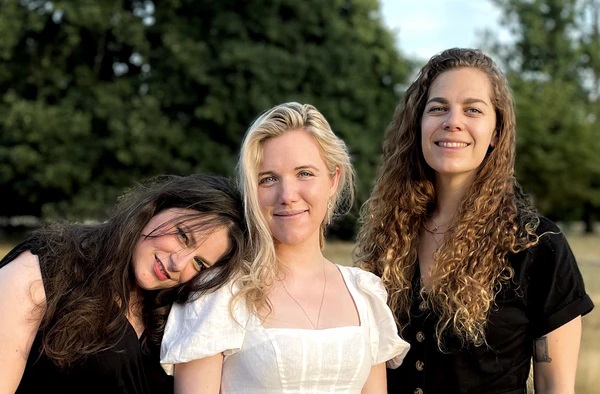
DF: It was very serendipitous. We did the Write Like a Grrrl poetry course together online during the pandemic. After that finished, we were the last few keen beans clinging onto the weekly practice. Then, we discovered we all lived within about five miles of each other. I think we were sitting around in blankets in Ruby’s garden trying to think of names, and one of us just blurted it out. It made perfect sense for us.
EP: The name is inspired by a trait familiar to most female creatives — ‘imposter syndrome.’ When we started working together and reading out poems, we’d introduce our poems with uninspiring caveats ‘sorry, it’s not very good but…’ we acknowledged our imposter feelings and decided to embrace them.
RC: Oh yeah, Em is the worst for that; she always starts by apologising. We’re trying to wean her off it. Especially as she always then reads out some amazingly brutal, fully rhyming epic that she somehow wrote in 15 minutes. If I could do that I’d never shut up about it. That’s one of the nice things about being in a collective — it’s so easy to trash your own work, but we all have each others’ backs.
RC: Well there’s always someone to sound things off against, so that helps speed up the editing process, and it’s also great practice for reading stuff out loud. I used to feel sick whenever someone read my work, even an essay at school, I was fiercely private. But now we do poetry sessions once a week, and we read out our work in progress. Perfectionism will break you. Theatre director and producer Jude Kelly once told me “Don’t send your work when it’s good; send it when it’s sh*t, or you’ll never send it.” As a mantra, it’s very forgiving. Thankfully I now have these two to curb any self-sabotaging.
EP: I hope I don’t sound too mawkish but the sense of community has changed the way I see poetry. I used to use poetry purely as catharsis but now I think it’s about communication and understanding. Poetry isn’t always meant to sit, angsty and brooding within locked-up pages. Often, it should be read aloud. I feel a visceral sense of relief whenever I read poetry out loud and so having a supportive space to do that is precious.
DF: I’m very extroverted, which is exhausting, and means I never prioritise writing. There are always other people who are more important. So the collective has forced me to give value to my writing, and to be able to work in a social environment.
EP: We chat for a while about life’s goings-ons. From work dramas to love life problems and then we pick out a keyword or theme from our conversation, perhaps a sentence that sounded slightly poetic. Sometimes we’ll pull out a tarot card for inspiration. We then do ‘sprints’ and spend ten quiet minutes writing. Then we read it out and give each other feedback.
RC: Then I distract everyone. I’m very distracting. And Dash is always the voice of reason, gently bringing us back to the task at hand. Honestly, we couldn’t do this without her.
DF: Oh honey, thanks for saying that, I was worried that I was the killjoy! I have inherited a lot of ‘let’s crack on’ energy from my mum. I like drawing inspiration from people’s everyday lives, and Ruby and Emily always have great stories. It adds to a sense of flow to pluck stuff from our friendship conversations and bring them into our poetry.
RC: Oh I was your friendly neighbourhood goth teen; I’ve always been into witchy sh*t. It started as an academic interest, and I actually studied witchcraft at university in that I read English at Exeter and studied under Marion Gibson, who specialised in witchcraft in literature. I fell in love with the history of all things occult, there’s a real link between creativity and these counterculture movements, and tarot was a natural progression. I think I have like three sets of tarot cards now? Four?
EP: Although I love the phrase ‘friendly neighbourhood goth’, I cannot relate! I preferred to stuff any darkness away and was keen to attribute anything sinister or sad to that ever reassuring ‘science.’ I still feel a visceral reaction of repulsion whenever I hear someone leaning on their horoscope for insights into their soul… ‘I am such a capricorn’ is a date-ender. I thought tarot was in the same category. But now I see it is a very useful tool to access and explore feelings and experiences. And there’s something undeniably magical about the way the cards have transversed the centuries.
DF: I always thought it was a game, to be honest. But by linking it with poetry, I’ve started to see it similarly. Like therapy. It helps you to examine and get to know yourself better. I’ve always been what I’d summarise as ‘a hippy realist.’ I love nature, family tinctures, ethically-sourced crystals, and tarot cards not because I think they are literal magic in isolation. All things that come from the Earth – from plants to people – are magic, in the scientific unlikelihood of any of it happening at all. It’s the magic of meaning, improbability, and surprise. A card comes up, and your brain shows you what you need to see and examine.
DF: I’ve long thought of tarot as an ancient form of therapy. It’s a way for you to distance yourself from your emotions and interpret the things going on in your life. I think the same can be said for poetry.
EP: Absolutely! It’s all about capturing a snapshot and a particular mood: tarot and poetry are very similar in this way.
RC: There’s a method of reading tarot – interpretive tarot – that has strong leanings towards how a card makes you feel. I like to think poetry is like that too, you can read it academically or you can just let it wash through you. Both are valid. There’s a lot of fear around poetry, thinking that you have to write it a certain way or read it a certain way, and if that’s your thing that’s cool but it’s not the only way of engaging.
I also think there are interesting links between this rise of female-oriented magickal interests and poetry on social media. If we think of witches as icons of othered female power, it’s no surprise to me that this is happening right now, in the face of an increasingly hostile society. Em, Dash and I — we’ve always casually referred to our poetry collective as a coven, and poetry feels like a kind of spellcraft to me.
EP: They are inextricably linked but there’s not always a clear correlation. Sometimes when my mental health is worst my poetry is best. Sometimes when my mental health is worse, my poetry’s crap. Sometimes when my mental health is very poor I can’t write at all and sometimes it’s all I want to do. The only thing I could do to ease my grief when one of my closest friends died was to write poetry. A few years later, I read back the poem I wrote in the first few weeks after her death and feel connected to her. I was surprised to find the simple act of reading some of the poems about her aloud to friends alleviated some of the more troubling symptoms of my grief. It was profoundly powerful and I was surprised. There’s the cliche of the depressed artist but I don’t think that needs to be true. Poetry can be about humour and lightness too. I once interviewed Dr. John Cooper Clarke and he was quite clear about it being about making money and humour, rather than alleviating demons.
RC: I’m so jealous you interviewed The Cooper Clarke, what a legend. I’m in a good place now, but I’ve struggled with mental health issues throughout my life. There were times when my depression and anxiety were utterly crippling. Creativity was always my safe space, a way to get the cacophony out of my head. When I was 17 I could barely get out of bed, but you wouldn’t know it from my creative output. So on the surface, I can see where the stereotype of the tortured creative comes from, but I wonder if it’s more that creativity is just core to a person’s being, and they use it in different ways depending on the circumstances? When I’m in a good place I can be more strategic, doing something ‘productive’ with it. I do coherent projects and have meetings and make plans and turn up to poetry sessions. When I’m not so good there’s no plan. It spills out chaotically, or, as Em pointed out, it doesn’t at all.
DF: I don’t come from a family of open talkers. Most things were intellectualised, and thus, could be argued about. I grew up with the message that if you were worth your salt, you were too smart for therapy. I’m a total convert today, because I just don’t believe that you can ‘sort things out in your own head.’ Mental health needs to be externalised to be understood, whether that’s through art or therapy, it doesn’t matter. Just get it out. The things that live in your head for free are usually the darkest, cruelest thoughts. They need to be expelled, and must be torn apart in the bright light of day.
RC: When I was a kid I dressed up as the two of swords for Halloween, it’s the one with a blindfolded woman holding a sword in each hand in the Rider Waite Smith deck. I thought it was creepy and badass. Looking back I was quite a weird kid.
EP: I like it when I get Death. Despite being a cynic it does scare me slightly and there’s always a perverse thrill in being scared. And anyway if i’m using it as a tool for writing death is much easier inspiration than one of the cards about money.
DF: The High Priestess — she just speaks to me! Or the Three of Cups. I love thinking about friendship and love in relation to magic and divinity — for me, that’s a positive way to traverse life. I’ve often said love is the closest thing I have to a religion, so I like to see it come up in a wholesome way in the cards.
EP: It doesn’t really. I sometimes find poets I like on Instagram but I also find an awful lot of populist poets who I don’t like. Perhaps Twitter makes me write fewer poems.
DF: Honestly, same. A lot of the time, it can enhance the imposter syndrome, I see the quality of other peoples’ work on social media, and there’s a voice in my head that tells me I don’t belong among them. However, I do think it’s important that people have been able to share their work without needing to get published. There are so many more voices out there now, and I’m also glad to see them. The reverse of comparing myself to others on Instagram is being bolstered by the fact that they’re there, sharing their stuff too.
RC: Totally; I think it’s amazing how it allowed new voices to get heard. Poetry has always thrived in new environments, and the rise of social media has allowed it to grow and adapt and modernise. Which isn’t to say it’s been a smooth ride. The democratisation of poetry has certainly been resisted in some camps, I see it when people sneer at the term ‘instapoet.’ This is a space where women specifically are in charge of their own voices, where they are not being gatekept by the establishment. Society accepts that poetry has different formats, styles, and rules — as long as it’s not young women or minority groups leading the charge. F*ck that. Respect instapoets. What makes a poet legitimate? Why is instagram or TikTok a lower form than a printed book? Poetry is what you make it, and if you write poems YOU ARE A POET, no matter who slags you off.
EP: Get a pen and some paper and scribble. It’s okay to write utter crap, just write something.
DF: And if you can’t write, read! Whether fiction or poetry, just make sure it’s not Twitter or your favourite news app. Be still, and read something you love that someone has worked hard to create — just for the joy of it.
RC: I second those points, but I’d also say remember your worth isn’t measured by your productivity. It’s a very capitalist way of thinking and not always the most conducive to creativity. Be kind to yourself; we all have off days. The important thing is you keep giving yourself time to write, and try to remember that you do it because you enjoy it.